October is Gentle Detox Fall Cleanse and join perceptive wellness club through October 31, 2026 (cohort 4)
Quarter 1 Perceptive Wellness Club Call Recordings - Guided Practices, course content and Curated Content
Quarter 1 for 2026 on 3/24/2026 Bonus call
Building a deeper relationship with your self-care habits.
Link to slides in Canva to view them. There are slides for each of the 10 habits that were added after the call. So you may not have seen them yet. The idea is to look individually at the one or ones you need to add back in for ideas. Apply what we learned to form a deeper relationship with that habit so it carries more meaning and allows for continued integrity with more ease.

Live kickoff call from cohort 4 to establish the focus and format. You can explore habit 1 a bit deeper.
NEW to habits, please use the Body Thrive book, by Cate Stillman. Please read Earlier, Lighter Dinner pages 3-30.
How are you designing your body?
How to have a body according to Ayurveda.
A crash course on habit evolution
Habit 1 read page 33-49.
Developing/Experiementing with a self-care practice:
Think about the structure of your household around food.
When is your meal planning taking place? (on paper, at the store, in the mornings, just before dinner time) (individually, with a partner or family meetings)
Does the time you eat dinner allow for 3 hours before bed without additional food, snacks, desserts, calorie drinks, or alcohol; does that feel right for you? If not, please note what is happening.
Do you feel like you need more structure for meal planning or it feels like more softening and flexibility is best?
How can I simplify my meals so I can focus more on enjoyment, being present with the food when I eat, and nourishing my body?
Embodying Earlier, lighter dinner:
Spiritually, do I feel better grounding myself with three breaths and feeling my feet push against the floor to be present with the food? Or would something else work better? Be curious about what truly feels right in your body, mind, and spirit.
Do I need to slow my pace a bit, less distractions and chew the food more to better assist and improve digestion and nutrient absorption?
Placing your hand below your belly button, let your attention rest here as well. (sacral chakra) This is an intuitive way to connect and ask/feel into what emotions are present. What does my body need right now? or just an affirmation. “I am nourishing myself from a place of calm awareness.” You may word the affirmation or prayer in your own words. One that you can reuse for dinner time. You are forming your own personal ritual that feels loving and supportive everyday.
Right now, for those dealing with any negative factors around dinner, working just with the first step is a starting point so you can begin to shift what is affecting your mood and choices. Keep it that simple.

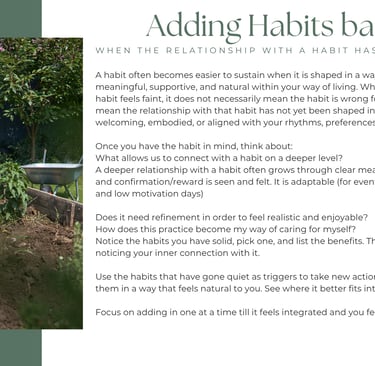
Below is for returning members and when a habit drops off. This method is also more effective when you can spend 30 days just focusing on the one habit till it is fully integrated. When new, you are experimenting with one habit per week to get a feel for what is working and what feels challenging.
Habit 1 (ELD) - Earlier, Lighter, Dinner. We will cover Spanda, applying habit evolution, and get you started on Identity Evolution (09/2026) (quarter 1)


2023 Curated video - Cate Stillman. Used with permission (WPA/Yoga Health Coaching).
Excellent for beginning with this habit, either in part or as a whole.


10/03/2024 recording. Identity evolution with the chakras
Habit 2 (ETB) - Early to Bed. Develop a relationship with rest (09/22/2026) (quarter 1)
Slides 15 to view on Canva
Guided Practice: Rest and Receive
The slides include a mini sleep workshop. I will add them below to view in the course. This is a prerecorded video, no live call this week.

NEW to habits, please use the Body Thrive book, by Cate Stillman. Please read Early to Bed, page 51-66.
Beginner & When Challenged by Sleep: Discover Your Rest Rhythm
At the beginner level, the emphasis is awareness and experimentation.
Begin learning:
how much sleep feels restorative
when natural sleepiness tends to appear
what evening activities support winding down
what time they need to enter bed to receive enough sleep
how dinner timing influences bedtime
morning feelings and level of tiredness or awakeness
Gather information from your own experience. Leave a few pages in your journal for writing out what you noticed. "Sleep journaling can show patterns."
Developing/Experiementing with a self-care practice create an evening rhythm:
At the developing level, the habit becomes more intentional.
Design an evening that naturally leads toward sleep.
This may include:
an earlier, lighter dinner
dimming the lights
finishing stimulating work earlier
transitioning away from phone or computer activity
bathing or washing
light chores
reading
meditation or sitting in silence or gentle stretching (yoga nidra)
a short healing-space practice
preparing the bedroom in advance
This is where habit stacking becomes particularly helpful.
For example: Dinner → kitchen completion → softer lighting → personal care → quiet practice → bed
Embodying Early to Bed:
Advanced Embodiment: Rest Becomes Part of the Way You Live
Sleep is woven into the larger relationship with subtle energy
You sense earlier in the evening when the system is ready to turn inward. You have your own ritual and ways to close the day. You already have the bigger picture in mind. You already feel the draw towards contributing to the greater good of the world and what you need to share that.
You are in the flow of what is showing up from the Universe and allowing that pulsation to connect you with the people, pets, and places that draw in our own defined experiences.
Reflection may feel deeper. Intuition may drift you into a space of healing and balance your own body before drifting to sleep.
There is flexibility. You can accommodate travel, holidays, social evenings, guests, and special events, which become variations rather than disruptions. The essential relationship with restorative sleep remains intact. You can apply stronger boundaries when more rest is needed.
The embodied question becomes:
How do I honor restorative sleep while still participating fully in my life?


posting prior years with habit 2 - shortly. (found video, it is combined with another habit. I may clip the audio for the sleep portion and post it here.
Here is the link to the 17 Slides. It includes deep sleep tips, Yoga Nidra. It is combined with self-massage, so this is weaved into some of the slides as winding down.


Self-Care Habit 3
Start the Day Right
Live Call Week with conversations on the first 3 habits
Start the Day Right with intention. Quarter 1 Habit 3 Live call on 09/29/26


Sitting In Silence/Meditation
Self-care habit 7 is meditation. This carries many options for your intention
10/27/2026 Slides on Canva (not available yet)


NEW to habits, please use the Body Thrive book, by Cate Stillman. Please read Early to Bed, page 81-95.
Beginner—Wake Up the Body and Breathe
If you are staying home, it might be 5–10 minutes of stretching, walking outside, a few sun salutations, gentle yoga, dancing to a favorite song, or moving through your home while consciously taking fuller breaths. Notice your circulation beginning to increase, your joints becoming more mobile, and your energy shifting from sleep into activity.
If you are someone who needs to run out the door, make the practice smaller rather than skipping the relationship altogether. Take a few deeper breaths when you stand up, stretch your arms overhead, move your shoulders and spine, walk briskly through the house, or take several conscious breaths as you step outside and begin your day.
Make the practice simple enough that you will actually do it.
Start with 3–5 minutes. Stretch while your coffee or tea is brewing.
Take a short walk outside.
Do several yoga poses you already know.
Put on one favorite song and move.
Roll your shoulders, reach overhead, gently move your spine, and breathe more fully.
Try box breathing:
Inhale for 4 → hold for 4 → exhale for 4 → hold for 4.
Inhale for four, pause for four, exhale for four, pause for four, using a comfortable count Just a few rounds can help you bring your attention back into your body before moving forward.
Developing/Experimenting with various breathing practices and movements to find yours. Please read : Prana: Life Energy pages 33-37 in everyday ayurveda cooking for a calm, clear mind by Kate O'Donnell.
At the developing level: Make It Yours.
Now begin connecting Breath Body Practices with something you genuinely enjoy.
If you love being outdoors, take your breathing practice onto the porch or walk as the sun comes up. If music changes your energy, create a morning playlist. If you love yoga, choose a short sequence. If gardening draws you outside, breathe and stretch before walking through your garden. The task of gardening is both habits working together.
This is where the habit becomes much more personal.
Instead of asking, “What exercise am I supposed to do?” begin noticing:
“What helps me feel awake, present, open, and connected to my body?”
You may also start recognizing that different mornings call for different practices. A tired body may appreciate slow movement and fuller breathing. A restless morning may feel better with walking or more active movement. A busy mind may respond beautifully to several rounds of box breathing before you begin moving.
You're developing a small library of practices
Embodying Breathe and Movement: Breath and Move as Spiritual Practice
At the embodied level, Breath and Move becomes part of your spiritual life. The practice may naturally lengthen, happen more than once during the day, or weave itself into moments without requiring extra effort.
You may begin your morning with movement, breathwork, mantra, chanting, prayer, or a practice connected to your lineage or spiritual tradition. Beauty and ritual may become part of it too—the sunrise, a candle, sacred music, or a place where you feel deeply connected.
As your breath becomes more conscious and your body more receptive, your subtle-energy awareness can become clearer too. Movement helps release excess tension and mental noise. Breath helps gather your attention. From that quieter, more connected state, it can become easier to notice the wisdom already moving through you.
This is where Breath and Move can begin to support intuitive development in a deeper way. You may become more aware of sensations, impressions, inner knowing, energetic shifts, or subtle messages that are easier to miss when the body is rushed or the mind is overstimulated.
A more developed morning practice might include 20–40 minutes of yoga or intentional movement, followed by alternate nostril breathing, mantra or chanting, and quiet stillness. In yogic tradition, alternate nostril breathing is used to balance the flow of prana and prepare the mind for meditation. In your own practice, it can also become a doorway into deeper listening.
The calm created through practice begins to travel with you. Stressful events still happen, but you have a stronger relationship with the place within you that can listen, receive, and respond.
Breath and Move becomes a clear path into subtle-energy awareness. It's a way to quiet the outer noise, feel the wisdom within, and deepen your relationship with your own intuitive abilities.
15 Breathwork Benefits: The Science Behind Breathing Practices article.


7 slides on Plant Diversity
Self-care habit 5, Plant based diet. 30 plants (spices, herbs, greens, nuts, seeds, legumes).
Nutritional Update for Physicians: Plant-Based Diets
Philip J Tuso, MD, Mohamed H Ismail, MD, Benjamin P Ha, MD, and Carole Bartolotto, MA, RDAuthors Info & Affiliations
Published Online: June 1, 2013
NEW to habits, please use the Body Thrive book, by Cate Stillman. Please read Plant-Based Diet, page 97-113.
Beginner—How many plants, nuts, seeds and legumes do you currently eat?
Discovering Your Plant Diversity
Begin by identifying the different plant species you consume in a typical week.
Include vegetables, fruits, leafy greens, beans, lentils, whole grains, nuts, seeds, herbs, and spices. You may be surprised by how many you already enjoy or discover that your meals revolve around a relatively small collection of familiar foods.
Your first opportunity is to expand that variety. Introduce one new plant each week, choosing something appealing, seasonal, or unfamiliar.
Explore different colors and plant parts, including roots, leaves, stems, flowers, fruits, and seeds.
Start noticing how different preparations influence your enjoyment and digestion. Ayurveda reminds us that nourishment is individual. Warm, cooked vegetables may be more suitable at certain times, while fresh greens and lighter meals may be appealing at others.
Your practice: Keep a simple weekly plant diversity list. Add one new plant and discover at least one enjoyable way to prepare it. Allow curiosity to guide your choices.
Developing/Experimenting with Are your food choices becoming more diverse, seasonal, and responsive to your body's needs?. Please look at the recipes in everyday ayurveda cooking for a calm, clear mind by Kate O'Donnell.
Embodying plants Breathe and Movement: .

Instead of a prerecording for habit 4, it is in this live call.
10/13/2026 live call. Conversations covering breathe practices, movement/toning and plant diversity. See if you are already at 30 plants. Add one new one in per week if that feels right to increase your personal diversity with plant physiology. You may find some inspiration in a new plant and learning a bit more about it, try preparations with it.
My new one is Honeybush tea. There are so many benefits; it is highly calming, so I want to learn more about it. I may not drink it every eve, but I do 2-3 times a week. It is new to me. I feel called to this one more than I did with Linden tea (the one all herbalists love and know well. It is calming as well).

Plants as Medicine Q & A on 07/23/2025
Plus the 11 Slides (I updated a bit on 10/13/26)


Self-Massage Healing with your own hands or with the elements
Self-care habit 6 is your Self-Massage.
10/19/2026 Prerecording (no live call)
13 Slides on Canva - click to view them.


Prerecording for self-massage
Explore many options for applying healing with your own hands or with an element like water to sooth your skin.
NEW to habits, please use the Body Thrive book, by Cate Stillman. Please read Self-Massage, page 133-144.
Beginner—
As a beginner, you don't need to create an elaborate Ayurvedic routine. You are simply exploring what is available and noticing your preferences.
Perhaps you try oiling your feet after showering. You may discover that massaging your scalp is relaxing before bed. Or perhaps using a dry brush briefly before bathing makes you feel refreshed. Start with something small enough that it feels enjoyable to repeat and easy to do.
I also want to recognize that self-touch is not comfortable for everyone. There are options on the slides for those that feel more comfortable with no touch options. Some examples are: allowing warm water to flow over your hands or feet, enjoying a warm foot bath, or feeling a gentle breeze outdoors are other ways to explore soothing sensory experiences.
We are building a positive relationship with this habit. Discover what works best for you.
Developing/Experimenting
Are you happy with the amount of time you spend on self-massage? At this level you may be settling in on when is it the best time to practice and really leaning towards the right style you are comfortable practicing.
The next step is developing a deeper relationship with self-massage or no-touch massage. You may recognize that warm oil massage feels especially nourishing in winter, while a short foot massage is what you enjoy after a long walk.
Are your shoulders frequently tense after sitting at your computer? Try a few minutes with a roller to soften the tightness. This gives you a clear time and place to add it into your day.
Bring greater integrity and care to the practice. You are or have created adaptable practices for times your daily routine is disrupted. A different practice or just a shorter practice may be the choice you make.
For example, on a busy morning, you might enjoy just one minute of scalp massage. On another day, you might create time for a full Abhyanga ritual followed by a warm shower. Cultivate enough familiarity that you can adapt it naturally.
It also opens the opportunity to explore your subtle-energy awareness. If a particular area feels tense, perhaps you pause and notice what sensations are present before deciding what kind of care would be helpful.
Embodying self-massage in a loving way. Please remember as women, daily breast massage is the greatest gift you can give yourself as a preventative method. Spending just 30-60 seconds keeps the softness in this area. My personal experience since fall of 2019 is that it has eliminated begine tumors that I have always experienced since puberty. They are all gone. The cancer specialists now understand hardness near the nipples is an indicator of potentual unwell cells. Please focus some of your time in this area to encourage soft subtle tissues thrive in your breasts.
The embodied practitioner combines intuitive awareness with discernment.
Another beautiful dimension is body sculpting through conscious awareness. By this, I mean appreciating the form of the body and exploring how massage, posture, movement, and visualization can support a more comfortable relationship with your physical self.
This is not about using intention to force the body into a new shape. It is about enjoying the body you inhabit and becoming more conscious of how you move, hold tension, and express yourself physically.
An embodied ritual might include warm oil, gentle massage, chanting, a meaningful mantra, and gratitude for the body and its remarkable capacity to maintain and repair itself.
The difference is the quality of relationship you bring to the experience.
What may have begun as a five-minute daily habit can become a beautiful expression of intuitive self-healing and collaboration with the Universe.
What Does Embodiment Actually Feel Like?
Embodiment might feel like:
Familiarity: You recognize your body's preferences without needing to analyze every sensation.
Freedom: You can enjoy a full massage ritual or choose not to massage at all, without guilt.
Connection: Your awareness of the physical body and your contemplative spiritual practices begins to feel more integrated.
Responsiveness: You recognize what is appropriate today rather than insisting on yesterday's routine.
Appreciation: Your body is no longer viewed primarily as something to improve but as a living partner deserving of care.
The embodied level is the feeling of a relationship becoming more intuitive and naturally expressed in everyday life.
A Short Inquiry: Listening Through the Body
Attention • Intention • Receiving
What part of my body welcomes attention today?
What form of care feels appropriate?
What am I learning about myself through this experience?
Your Invitation This Week Explore • Notice • Enjoy
Choose one form of self-massage or sensory care to explore this week.
Beginner: Try one new technique or tool for a few comfortable minutes.
Developing: Adapt an existing practice to how your body feels on different days.
Embodied: Create an intentional self-healing ritual incorporating intuitive awareness, beauty, or subtle-energy work.
Reflection: What did this practice teach me about the ways I enjoy receiving care?
If you're new to self-massage, perhaps explore one of the techniques we've discussed. You may find that a simple foot roller or a little oil on your hands is a lovely addition to your day.
If you already practice self-massage, consider how you might deepen your relationship with it. Are you responding to your body's preferences, or following the same sequence each time?
And for those of you working at the embodied level, perhaps there is an opportunity to bring more beauty, intention, or intuitive awareness into an existing ritual.
This might involve lighting a candle, chanting a mantra, practicing Hara awareness, or inviting a sense of gratitude into the experience. Over time, self-care becomes a lived expression of how you honor your wellbeing.
Additional Safety and Resources
Gentle massage can support relaxation and muscular comfort, but different techniques are not appropriate for every body. Avoid dry brushing over inflamed, irritated, broken, or reactive skin. Likewise, avoid vigorous pressure over varicose veins, unexplained swelling, or painful areas. People experiencing persistent edema, suspected blood clots, skin infections, or significant medical conditions should obtain appropriate professional advice before attempting specialized lymphatic massage.
Cleveland Clinic
For members who have experienced trauma, choosing water, comfortable textiles, movement, or touch-free meditation is an equally valid way to participate in the sensory-awareness aspect of the habit.
For further learning, these sources may be useful:

Quarter 1 week 6 Self Massage and Deep Sleep Live Call on 10/29/2024
Crown Chakra is the skin - nourish it with the energy of this chakra when you think of it to fully infuse healing energy into your body when doing self-massage.
This practice we were going to do live, you will see this is the messed up part in the video. This one is saved in our Playlist as well:
Lymphatic Drainage Massage for Face, Head, & Neck Swelling or Lymphedema - By a Lymphedema Therapist • Swollen Face, Head, or Neck? The Complete
Experience a new path of self-discovery with us. We would love to have you in our community.
Located in Blue Springs, Missouri (in Kansas CIty area). USA. Courses are in English. The timezone is Central (Chicago-USA to check the course call times.) We are an international group of women with a passion for learning.
Contact
Request information guides & Schedule a free wellness goals conversation.
perceptivehealings@gmail.com
(I do not respond to spam emails)
Brenda Green, Intuitive Wellness Mentor
© 2025. All rights reserved.